

What it is about
Since the Financial Institutions Act entered into force on 1 January 2020, independent portfolio managers and trustees in Switzerland need a FINMA licence – yet the day-to-day supervision lies elsewhere. It is carried out by supervisory organisations (SOs). For a portfolio manager, the SO is the counterpart for audits, notifications and supervisory questions. This article explains the role of the SOs, what they review and how to choose and, if needed, change your SO.
What a supervisory organisation does
The legal basis is in Title 3 of the Financial Market Supervision Act (FINMASA) and in FinIA:
- Ongoing supervision: SOs carry out the ongoing supervision of portfolio managers and trustees (Art. 43a para. 1 FINMASA; Art. 61 para. 2 FinIA).
- Scope of review: the SO verifies whether its supervised firms meet the requirements of FinIA, observe their duties under the AMLA and, where they provide financial services, under FinSA (Art. 84 para. 1 FinIO).
- Follow-up of findings: if the SO detects breaches, it gives the firm an appropriate period to restore compliance; if the period is not met, it informs FINMA (Art. 43b para. 2 FINMASA).
- Rulings: decisions in the form of rulings are reserved to FINMA (Art. 84 para. 5 FinIO).
- Funding: SOs finance their activity through contributions from the firms they supervise (Art. 43f FINMASA).
The SOs themselves need FINMA authorisation, are effectively managed from Switzerland and are supervised by FINMA (Arts. 43a, 43c and 43d FINMASA). FINMA provides them with guidelines for auditing and supervision, including a system of risk assessment (Art. 84 para. 2 FinIO). The supervisory standard is therefore the same, whichever SO you choose.
The supervisory organisations authorised by FINMA
FINMA publishes the list of authorised SOs. As at 5 November 2026 it shows four:
| Supervisory organisation | Registered office |
|---|---|
| AOOS – Schweizerische Aktiengesellschaft für Aufsicht | Zurich |
| OSIF – Organisme de Surveillance des Instituts Financiers | Geneva |
| OSFINcontrol AG | Zug |
| SO-FIT – Organisme de Surveillance pour Intermédiaires Financiers & Trustees | Geneva |
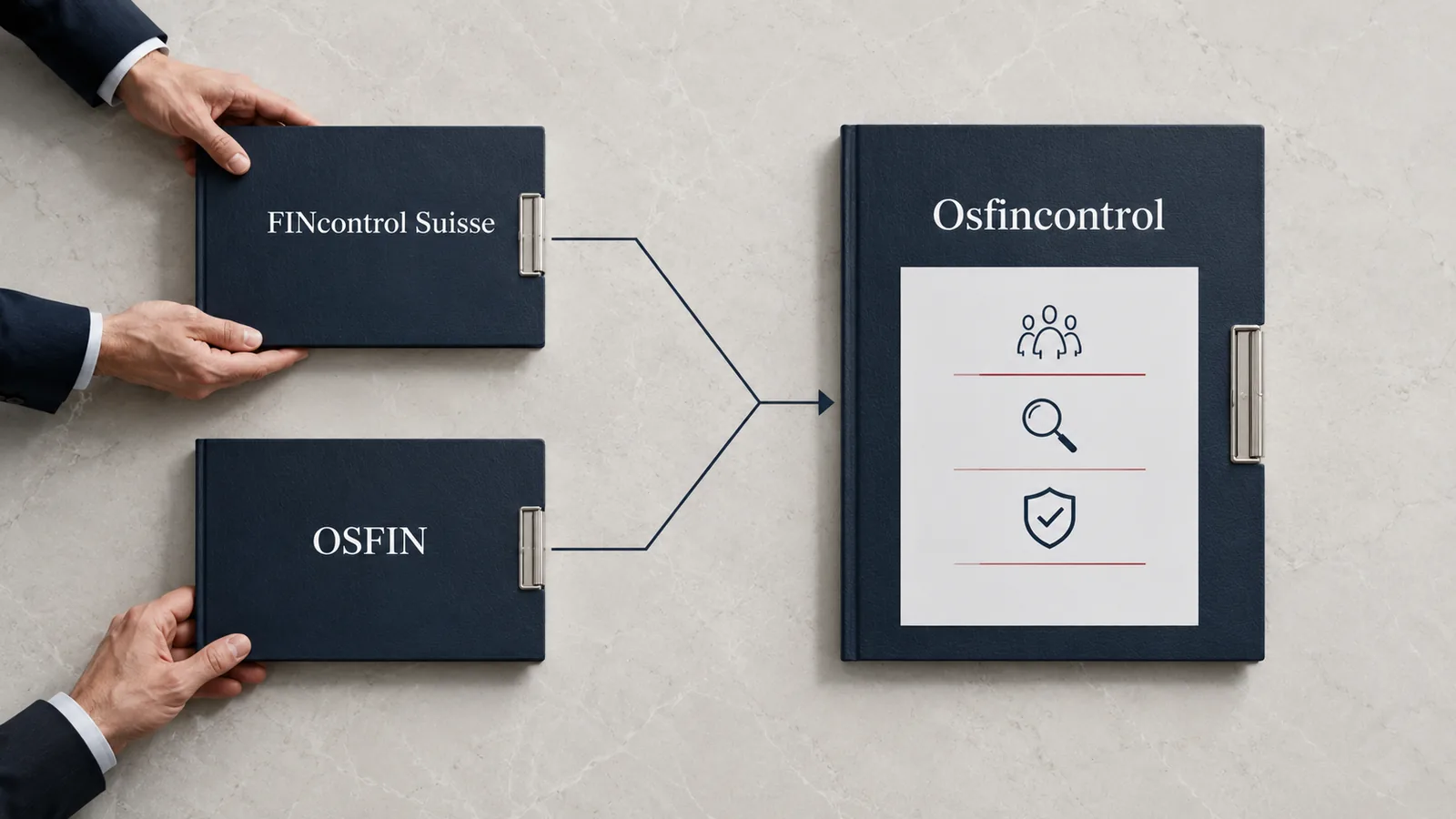
OSFINcontrol was created from the merger of FINcontrol Suisse and OSFIN, which FINMA approved in November 2025; our article on the OSFINcontrol merger has the background.
Audits and reporting
- Audit firm: the portfolio manager appoints an audit firm in accordance with Art. 43k FINMASA for the annual audit, unless the SO carries out the audit itself (Art. 62 para. 1 FinIA).
- Audit cycle: the SO may extend the cycle to a maximum of four years, taking account of activity and risks (Art. 62 para. 2 FinIA).
- Years without an audit: the firm submits a report on its compliance with the law to the SO, which may be in a standardised format (Art. 62 para. 3 FinIA).
- Changes: changes to the facts on which the licence is based are notified to the SO, which forwards them periodically to FINMA (Art. 22 FinIO).
- Duty to report: significant incidents are reported to the SO immediately (Art. 43l para. 2 FINMASA).
The current review priorities of the SOs, in particular on FinSA rules of conduct, are summarised in our article on the 2026 supervisory review.
Step by step: choosing your supervisory organisation
- 1Clarify your profilebusiness model, client base, size and the language you want to work in with the SO.
- 2Compare the SOsaffiliation agreement, supervision concept, fee structure, communication channels and audit firms used.
- 3Make contactdiscuss your project with the preferred SO before filing; FINMA's licensing process requires you to choose and contact an SO first.
- 4Send the applicationsubmit your licence application with enclosures to the SO via FINMA's survey and application platform (EHP).
- ✓Receive confirmationthe SO confirms your affiliation in writing; with this confirmation you file the application with FINMA (Art. 7 para. 2 FinIA).
The whole licensing path is described in our article on how to become a licensed portfolio manager.
Changing your supervisory organisation
According to FINMA, portfolio managers and trustees change their SO at the end of the year, and the licence change request reaches FINMA by 15 November. Plan a change early: talk to the current and the new SO, check notice periods in the affiliation agreements and prepare the documents the new SO requests.
Checklist
- SO chosen and affiliation agreement reviewed
- Audit firm appointed or audit by the SO agreed
- Audit cycle and reporting dates in the compliance calendar
- Process for notifying changes to the SO defined
- Annual report on compliance prepared for years without an audit
- Contact person for SO enquiries named, with a deputy
- For a change of SO: request timetable aligned with FINMA's 15 November deadline
How Peak Compliance supports you
Peak Compliance works with the supervisory organisations AOOS and OSFINcontrol, prepares audits and notifications and represents your compliance function in the dialogue with your SO. For new firms, we guide the portfolio manager licence including the choice of SO; background is in our FinIA knowledge hub. For a first conversation, reach us via the contact page.