


Fintech License Switzerland – How to get it
Background
The Swiss Fintech licence is a regulatory framework designed to promote innovation within the financial sector. This licence allows Fintech companies to operate with greater flexibility compared to traditional banking licences. Particularly in the areas of payments and digital financial services.
Driving Innovation
The Swiss Fintech licence is regulated under Article 1b of the Swiss Banking Act. It allows financial institutions to commercially accept public deposits of up to CHF 100 million. Such deposits are held without being invested or earning interest.
This measure aims to reduce barriers for fintech companies entering the market. The provisions of the Banking Act still apply with necessary adjustments. If a company surpasses the CHF 100 million limit, it will require a full banking licence. The Fintech licence, therefore, serves as an intermediary step between the sandbox (allowing the acceptance of public deposits up to CHF 1 million without a licence) and a full banking license.
Business Cases for Swiss Fintech license
The Swiss Fintech licence accommodates a wide range of business models. This flexibility allows emerging and yet-to-be-developed business models to potentially benefit from the eased regulatory requirements. It is particularly advantageous for companies that offer services similar to those of banks but do not engage in traditional core banking activities.
The Fintech licence is especially relevant for businesses that involve holding customer funds. This practice previously required a full banking licence, with few exceptions. With the new licence, companies can accept public deposits of up to CHF 100 million without needing a full licence.
- DIGITAL PAYMENT PLATFORMS:
Companies offering digital wallets or mobile payment services that facilitate transactions between users.
They can also operate interest-free deposit business models. - CROWDFUNDING PLATFORMS:
Fintech companies providing crowdfunding services where collected funds are temporarily held before being released to project owners. - CRYPTOCURRENCY EXCHANGES:
Businesses that operate crypto exchanges, allowing users to buy, sell or hold digital assets.
They can use the Swiss Fintech licence to manage client funds in FIAT currencies. - PEER-TO-PEER LENDING:
Fintech companies enabling peer-to-peer lending, allowing individuals to lend money to others directly via an online platform.
What are the requirements for a Swiss Fintech Licence?
FinTech License Requirements:
How long does it take to get a Fintech License in Switzerland?
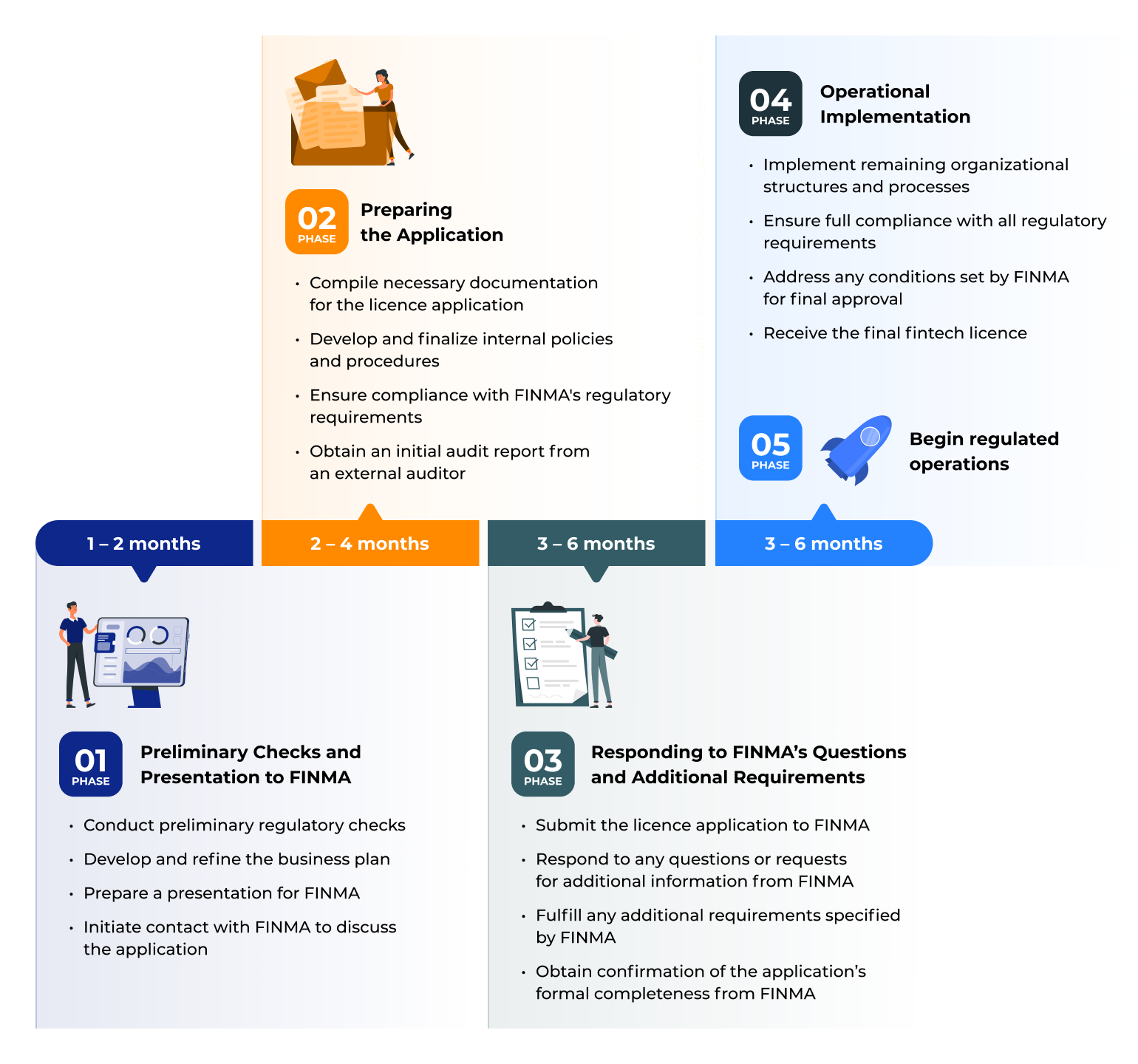
Obtaining a fintech licence in Switzerland involves several key phases, from preliminary checks to final operational implementation. Each phase requires specific actions, such as preparing the application, responding to regulatory queries, and setting up the necessary infrastructure to meet compliance requirements.
The process is divided into several phases, each with its own timeline and set of activities:
- PHASE 1: PRELIMINARY CHECKS AND PRESENTATION TO FINMA (1–2 MONTHS):
Initial stage involving preliminary checks and preparation of a presentation for FINMA.
The company establishes first contact with FINMA to discuss the application and business plan. - PHASE 2: PREPARING THE APPLICATION (2–4 MONTHS):
The company prepares the detailed licence application, gathers required documentation, develops internal policies, and ensures compliance readiness.
An initial audit report must be prepared by an external auditor. - PHASE 3: RESPONDING TO FINMA’S QUESTIONS & ADDITIONAL REQUIREMENTS (3–6 MONTHS):
FINMA reviews the application and may request clarifications or additional documents.
The company must respond to questions and fulfill regulatory requests.
FINMA will confirm formal completeness of the submission. - PHASE 4: IMPLEMENTATION (3–6 MONTHS):
After conditional approval, the company implements remaining systems, processes, and structures to meet regulatory standards.
Once all conditions are satisfied, FINMA grants the full fintech licence, enabling regulated business activities.
How much does it cost to get a Swiss Fintech Licence?
FINMA is responsible for issuing fintech licences and overseeing fintech companies in Switzerland. Similar to a banking licence, obtaining a fintech licence incurs costs covered by fees and supervisory levies. FINMA has added a section to its Fees and Levies Ordinance for fintech companies.
The supervisory levy includes a fixed base fee of CHF 3,000. Additional variable fee based on the company’s balance sheet and gross income apply.
Additionally, FINMA estimates further costs for financial and regulatory audits at around CHF 50’000. This is significantly lower than for a regular banking licence.
Beyond FINMA’s fees, obtaining a fintech licence involves several additional expenses. If the application process takes 18 months, the total costs can be estimated as follows.
Exemplary fee estimate:
- Consultancy fees: CHF 30’000 – CHF 100’000
- Internal employees: CHF 120’000 – CHF 250’000 per employee annually (for 5 employees over 18 months: CHF 750,000 – CHF 1,875,000)
- Office space: CHF 4’000 – CHF 10’000 monthly (for 18 months: CHF 72,000 – CHF 180,000)
- IT-Infrastructure and consulting: approx. CHF 100’000 (for 18 months)
- Accounting fees: CHF 15’000 – CHF 35’000 for 18 months (accounting based on Swiss Code of Obligations)
- Auditor fees and initial audit report: CHF 40’000 – CHF 50’000
- FINMA fees (including supervisory levies): CHF 3’000 (base fee) + CHF 50’000 for audit-related expenses
The total estimated cost of obtaining a fintech licence ranges from approximately CHF 1.1 million to CHF 2.4 million.
In case the Swiss Fintech plans to offer payment solutions (e.g. FIAT) with 3rd party banks and payment providers the following additional estimated IT costs will incur:
- Core banking and interbanking infrastructure: CHF 750’000
The total estimated cost of obtaining a fintech license in Switzerland, including the additional IT costs for offering payment solutions (e.g., FIAT) with third-party banks, ranges from approximately CHF 1.8 million to CHF 3.2 million.
Ways, we can support you
We can assist you in effectively aligning your business model with legal and regulatory requirements.
We offer comprehensive support across several key areas to help you navigate the complexities of the fintech landscape:
- Business strategy development
- Legal and regulatory guidance
- Compliance management (including KYC and Anti Money Laundering (AML))
- Technology solutions (including provider selection and software implementation)
Our team and network of subject matter experts ensures you have the expertise and resources needed to drive your business forward.